
Huttari dance : A sacred intertwining Traverse between the Cosmic realm & Sornatic Agrarian Turf
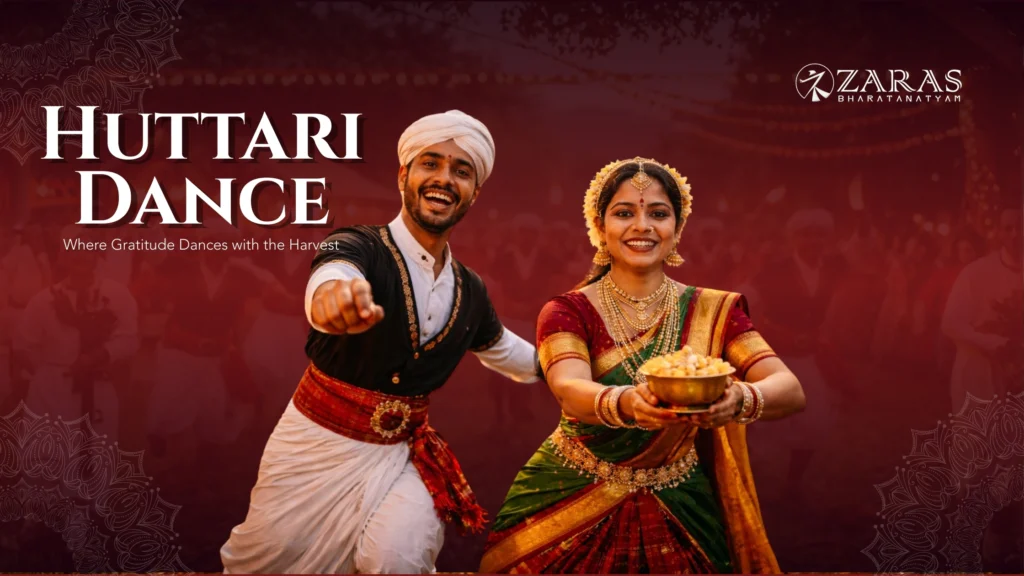
Huttari dance is a scintillating and coruscating folk dance from the Coorg region of Karnataka state India. Huttari is popularly known as ‘puttari’ which etymologically means ‘new rice’.A unique feature of this art form is chiefly the peasants belonging to the kodava community take active participation in the rice harvest festival during the late November/ December. Kodavas are hailed and glorified as the special and munificent Mono ethno linguistic sect of kodagu region.
This dance is performed to perpetuate their genuine indebtedness to the bountiful benevolence of nature, ancestors and sublime and sacred deities. This awe inspiring and grandiose bean feast is commemorated during the full moon day of karthika & margasira months of Hindu Calendar. On the day of propitious and felicitous Jamboree the houses are bedecked and embellished with mango leaves and marigold flowers. The fiesta commences with a ritualistic and ominous gun shot harbingering the harvest time ensued by anointed and sanctified rice being borne home to placate and conciliate the deities.
This art form is not a sheer means of merriment but also a ceremonious and mystical carnival of Puttari ,new rice, expressing and signaling their societal exultation, conjugal legacy and the profound bond with their roots.Huttari is prominent and eminent for dynamic locomotion and syncopated ramification. Huttari is customarily enacted in the vast expanse of borough foliage (mands) and patio and enclosure of patrimonial homesteads ( Ain Manes)
The dancers habitually organise themselves in a vast synchronous circle. Their sturdy, strenuous and strapping shiftings are shaped, prompted and solemnly urged by the celestial tandava. The unique and monopolic dance of Lord Shiva. The dancers very meticulously engage themselves in high hopping followed by a poised one foot stay before plunging into a cadenced Jump. The momentum of the dancers commences the leisurely and gentle pace frenziedly culminating in an escalation mirroring and harbingering the exhilaration and simulation of the abundant reaping festivity.
Huttari dance is a consortium expression that holds under it’s purview multitudinous discrete divertions having it’s own definite and unique accessories, furnishings and improvisations which has its own magnitude. They are Bolak- aat,ummatt-aat, komb- aat and huttari kol-aat. The music of huttari is primordial and propelling which are wielded by the conventional devices implemented for ages viz-Dudi, pare, pipes and horns.
The ensembles used in this art form are most entrancing and enthralling aspects that aids and uplifts the ocular pageant and makes the total and complete effect of the performance incomprehensible and incredible. Men are robed in time revered kupya engirdled by chele, a peechekathi inserted into the girdle, and paree adorned as head gear. Women are clad in Coorgi fashioned saris in poise finesse grandiose coupled with a babushka and long established decorative ornamental accessories known as kokhethathi.
Besides the harvest festival, huttari nritya is a demonstration and flaunting of community solidarity and cohesion. This season gives an intrinsic and invisible clarion call to all the villagers to assemble in reverence and piety for brimming and overflowing abundance. The hymns of poli poli deva reverberates through the bounteous pasture binding and intertwining seamlessly the mystical universe and the corporeal domain of harvesting.
